Previous Page Page 2 of 3 in the precipitationOutlook category Next Page
# Saturday, October 23, 2010

RAMDIS GOES-11 Water Vapor Image October 19, 2010 at 2:30 p.m. Click
RAMDIS GOES-11 Water Vapor Image
October 19, 2010 at 2:30 p.m.

Sunday evening through Wednesday afternoon, another energetic cutoff upper level low spun showers and thunderstorms into Southern California, increasing water year rainfall totals for many stations to near or above normal. Precipitation amounts varied widely, with some stations recording a few hundredths of an inch or less, and some as much as an inch or more. As was the case with the upper low at the end of September, this system produced a number of strong thunderstorms. A severe thunderstorm warning was issued as a result of a cluster of strong thunderstorms in the Antelope Valley Tuesday evening.

Downtown Los Angeles (USC) was one of those stations that didn't have its rain bucket in the right place. The station recorded only 0.08 inch from Sunday evening to Wednesday afternoon, bringing its water year rainfall total to 0.51 inch, which is about 0.16 below normal. Here is an archived Public Information Statement (PDF) from the NWS with some rainfall totals from around the area.

The Aug/Sep value of the Multivariate ENSO Index (MEI), released October 6, dropped another 0.18 sigma to -1.99. This is the lowest value of the MEI since Jul/Aug of 1955, and ranks the current La Nina as the strongest in the MEI record for the Aug/Sep season. Equatorial SST have continued to cool, and this plot of 5-day TAO/TRITON SST shows anomalies of -2.0°C or greater extending west to nearly the dateline.

Cooling of SSTs in the Central Pacific appears to have been enhanced by strong 850mb easterly winds associated with an MJO which propagated into the Western Pacific over the past 2 weeks and slowly diminished in amplitude. Divergence aloft associated with the MJO appears to have enhanced typhoon and tropical storm development in the Indian Ocean and Western Pacific. CIRA TPW loops show a lot of tropical moisture being injected into an extending Pacific jet. This could amplify rainfall amounts along the west coast of the U.S. the next few days.

There's been some drizzle and light rain in the Los Angeles area this morning. BUFKIT analysis of 12z NAM data for Van Nuys and LAX generates about 0.1 inch of rain late Sunday afternoon and evening. The bulk of the precipitation is forecast to occur in the northern two-thirds of California and into the Pacific Northwest. We'll see!

More information concerning Southern California weather can be found using our WEATHER LINKS page.


Saturday, October 23, 2010 10:26:24 AM (Pacific Daylight Time, UTC-07:00)  #    Disclaimer  |   | 
# Thursday, September 30, 2010


Composite Precipitation for Eight Moderate to Strong Transitional La Ninas
(Mouse Over Image is Composite Precipitation for 16 La Ninas)

Updated October 6, 2010. Replaced 1975 with 2007 in composite of climate division precipitation for eight transitional moderate to strong La Ninas, and other revisions.

Monday at 12:15 p.m. PDT the temperature at Downtown Los Angeles (USC) reached 113°F (45°C). This is the highest temperature recorded downtown since weather recordkeeping began in 1877. All-time and daily records were broken at several location. Here's an archived NWS Public Information Statement with a list of the records that were broken.

A moist south to southeasterly flow associated with a high over the Great Basin and an upper low off the coast resulted in some thundershowers (and rainbows) in the Los Angeles area yesterday, and there's a chance of more thundershowers today. According to the NWS zone forecasts, a chance of thunderstorms will continue in the mountains through Saturday evening. (See update below.)

Since the peak of last Winter's El Nino, there has been an unprecedented drop in the Multivariate ENSO Index (MEI). MEI bimonthly (e.g. Sep/Oct) seasonal ranks range from 1 to the total number of years for the season in the record, currently 60 or 61. A rank of 1 represents the strongest La Nina for the season, and a rank of 60 or 61 the strongest El Nino. Based on MEI seasonal ranks, in six months ENSO conditions switched from the fifth strongest El Nino for the Feb/Mar season to the second strongest La Nina for the Jul/Aug season. As Klaus Wolter pointed out in his September 3rd MEI discussion, the only stronger La Nina in the MEI record for the Jul/Aug season was in 1955, and the last time the MEI was lower in any season was 1975.

In all 11 cases since 1950 in which the MEI was -1.0 or less in the Jul/Aug season, La Nina conditions persisted through the Nov/Dec season. In all but two cases, 1950 and 1964, the MEI remained below -1.0 from the Jul/Aug season through the Nov/Dec season. Most ENSO assessments project that La Nina conditions will persist through at least the end of 2010.

As they say, past performance does not guarantee future results, but in the cases of well established La Ninas and El Ninos, historical composites can provide some insight into what is likely. CPC's ENSO Temperature & Precipitation Composites page now includes composites which incorporate recent precipitation trends. Frequency of occurrence maps are also included for each composite. These composites indicate coastal Southern California has been trending drier in the rain season during the past 15 years. The composite plus trend plot for Jan-Feb-Mar precipitation anomaly is particularly dry in coastal Southern California, indicating negative anomalies in excess of 3 inches, with a high frequency of occurrence.

To get an idea of how US precipitation anomalies might differ in a strong La Nina versus the more general La Nina case, the ESRL/PSD US Climate Division Dataset Mapping Page was used to construct maps of US composite precipitation anomalies. The two cases can be compared by moving the mouse cursor over the image. The initial image is a composite based on eight moderate to strong La Nina years which were preceded by El Nino or neutral conditions. The "mouse over" image is a composite of 16 cases* in which the MEI was in the lower 30%-tile of MEI ranks.

Another consideration in assessing potential ENSO impacts is the likelihood that a La Nina (or El Nino) will result in either extremely dry or extremely wet conditions. Here are maps showing the risk of precipitation extremes for the periods Nov-Dec-Jan, Dec-Jan-Feb and Jan-Feb-Mar during La Nina. These were generated using the ESRL/PSD page Risk of Seasonal Climate Extremes in the U.S. Related to ENSO. According to these maps, Southern California isn't likely to have an extremely dry 2010-2011 rain season, although CPC ENSO composites suggest there is at least some possibility of a dry rain season, particularly in the period Jan-Feb-Mar.

CPC's current operational precipitation outlook for Nov-Dec-Jan, issued September 16, 2010, shows roughly equal probabilities of above average, near average, or below average precipitation in the Coastal Southern California climate division. As the rain season progresses, these probabilities become more skewed toward below normal precipitation. In the period Jan-Feb-Mar the probability of below normal precipitation is calculated to be about 40%, while the chances of above normal drop to around 25%. The skew become slightly more pronounced in the period Feb-Mar-Apr.

All of this suggests below average precipitation in the Coastal Southern California climate division for the period November 2010 through March 2011. How much below average? Perhaps on the order of 3 to 6 inches. Over the 16 years used in the La Nina climate division composite, rainfall at Downtown Los Angeles (USC) has ranged from 7.17" (1971) to 16.00" (1955), with an average value of 10.95". This is about 72% of the normal 15.14". If only the lowest 8 MEI ranked (strongest La Nina) years are included, the average rainfall for Los Angeles works out to 11.08", or about 73% of normal.

Although it appears unlikely, average to above average seasonal rainfall could occur. Also, damaging storms with heavy or prolonged precipitation are still a possibility.

*The 16 years in the La Nina composite were taken from the 19 lowest MEI ranks for Sep/Oct. This includes 1950, 1954, 1955, 1956, 1961, 1962, 1964, 1967, 1970, 1971, 1973, 1974, 1975, 1988, 1995, 1998, 1999, 2007 and 2008. The marginal La Nina years of 1961, 1967 and 1995 were excluded in the 16 year set. An Oceanic Niño Index (ONI) based selection of cold episodes for SON would include 1984 and 2000, and exclude 1961, 1967 and 2008.

Update October 1, 2010. Intellicast.com composite radar shows some strong thunderstorms in Southern California this afternoon, with hail reported, and tops indicated at 35,000 to 40,000 ft. The moist subtropical flow is forecast to continue through Sunday, and along with it, a chance of showers and thunderstorms.

More information concerning Southern California weather can be found using our WEATHER LINKS page.

Thursday, September 30, 2010 2:33:23 PM (Pacific Daylight Time, UTC-07:00)  #    Disclaimer  |   | 
# Saturday, June 05, 2010

Click
Niño Region SST Anomalies

Woodland Hills (Pierce College) topped the 90° mark for the first time this year Memorial Day weekend, and after cooling a few degrees during the week, temperatures are back into the 90's this afternoon. A quick look at temps around the area shows temps near 70 on the coast; 80's to 90's in the valleys, and triple digits in the deserts.

Reflecting the transition to ENSO neutral conditions, the Multivariate ENSO Index (MEI) for April-May declined to 0.54. According to the CPC's Weekly ENSO Update, issued June 1, the latest weekly SST departures are -0.6°C (Niño1+2), -0.4°C (Niño 3), -0.2°C (Niño 3.4), and 0.4°C (Niño 4).

In his May 2010 MEI discussion Klaus Wolter projected the probability of a La Nina event emerging by the end of 2010 at roughly 50%. In it's May 2010 ENSO Quick Look, the International Research Institute for Climate and Society (IRI) put the probability of La Nina conditions from the August-October season through the remainder of 2010 at 42%. We'll see!

Downtown Los Angeles (USC) has recorded 16.36 inches of rain since the water year began July 1. This is more than an inch above the 1971-2000 annual climate norm of 15.14 inches. The water year ends June 30. Climatology and current forecasts suggest it is unlikely that this total will change by more than a hundredth or two before the end of the month.

More information concerning Southern California weather can be found using our WEATHER LINKS page.


Saturday, June 05, 2010 4:22:40 PM (Pacific Daylight Time, UTC-07:00)  #    Disclaimer  |   | 
# Tuesday, April 06, 2010

NRL Day/Night Visible Satellite Image - April 4, 2010 - 9:00 a.m. PDT Click
NRL Day/Night Visible Satellite Image
April 4, 2010 - 9:00 a.m. PDT

This week's Pacific system produced more rain in Southern California than recent similar troughs. The front associated with the system stalled as it approached the Los Angeles basin, and the low level inflow and jet dynamics helped sustain rain rates as the front dissipated.

Downtown Los Angeles (USC) recorded 0.60 inch of rain, bringing the water year total to 15.26 inches, which is above the 1971-2000 annual climate norm of 15.14 inches*. Here's an archived copy of a NWS Public Information Statement with some rainfall totals from around the area.

The water year ends June 30, so we still have a few weeks to add to our rainfall total. Los Angeles rainfall was below normal for the month of March, but we're already above normal month to date for April and it looks like more wet weather could be on the way. Recent runs of the GFS and ECMWF have been suggesting another system will affect Southern California the Sunday evening to Monday timeframe, and also project the possibility of another system midweek. We'll see!

More information concerning Southern California weather can be found using our WEATHER LINKS page.

*The average annual rainfall for Los Angeles of 15.14 inches is computed on a calendar year basis for the 30 year period 1971-2000. Technically it is not a water year average, but by convention it is used as a reference for water year rainfall. For details about how normal temperature and precipitation values are computed, see CLIMATOGRAPHY OF THE U.S. NO. 81 - Monthly Station Normals.


Tuesday, April 06, 2010 8:39:27 AM (Pacific Daylight Time, UTC-07:00)  #    Disclaimer  |   | 
# Friday, March 26, 2010

Global Wind Oscillation (GWO) November 1, 2009 - March 24, 2010 Click
Global Wind Oscillation (GWO)
November 1, 2009 - March 24, 2010

After peaking at a standardized relative AAM anomaly of 2.21 around February 5, 2010, the Global Wind Oscillation (GWO) has plunged 3 SD in relative AAM to a value of -0.90. This is the lowest value of relative AAM anomaly since mid October, 2009. Much of the loss in AAM was from the mid latitudes of the NH. From the week of February 22-28 to March 19-25, 7-day averaged 250 mb Zonal Mean Zonal Winds decreased from about 43 m/s at 30°N to 33 m/s at 30°N-45°N. The decrease in relative AAM reduced the likelihood of an extended and southward displaced North Pacific Ocean jet, and associated Southern California El Nino impacts.

In fact, there has been no measurable precipitation at Downtown Los Angeles (USC) since March 6, 2010. Los Angeles rainfall is now 2.23 inches below normal for the month of March, and only 1.15 inches above the water year norm for the date.

In the last week there has been an increase in relative AAM from about 40°N to 50°N. The GWO and AAM appears to have bottomed out and cyclical subseasonal processes may be working to revitalize Western Pacific convection and El Nino related forcing. If the GWO continues its current orbit, relative AAM would be expected to increase in the 6-10 day period.

The GFS and ECMWF have been showing a strong Pacific jet and trough affecting the West Coast next week. There are significant differences in the GFS and ECMWF model solutions, and although 5-day model performance has been good recently, performance often suffers during seasonal transitions. This morning's 12z GFS puts the initial focus of the event in the Pacific Northwest early in the week. Precipitation is forecast to spread into Northern and Central California, and finally Southern California, as the week progresses, and the trough deepens and moves onshore.

It's way too early to say how this system will affect Southern California. Many processes are in play that could affect the amount of precipitation here, pro or con. Yesterday afternoon's 00z ECMWF appeared to project a wetter solution for Southern California than this morning's 12z GFS, with the upper low and trough evolving a little more to the west. It does look like there is the potential for heavy snow in the Sierra. We'll see!

Update 04/03/10. The frontal band and upper low associated with the trough that moved through the area overnight Wednesday into Thursday produced some showers and some spectacular clouds in the Los Angeles area. The bulk of the precipitation occurred from Central California north into the Pacific Northwest. The upper low stayed offshore as it moved down the coast and past the Los Angeles basin. Avalon and some mountain locations recorded more than 0.1 inch of precipitation, but generally amounts south of Pt. Conception ranged from a trace to few hundredths. Here's an archived copy of a NWS Public Information Statement with some rainfall totals from around the area. A similar system is forecast to produce some rain in Los Angeles area Sunday night. BUFKIT analysis of 18z NAM data for Van Nuys projects about 0.4 inch of precipitation. The 09z SREF shows a high probability of measurable rain, but a sharp decrease in the probability of more than 0.1 inch/day south of Pt. Conception. We'll see!

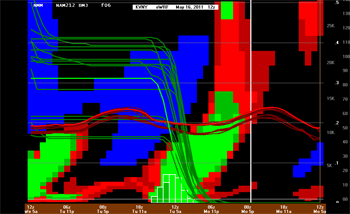
There was an interesting lenticular wave train northwest of Los Angeles earlier this month. The situation was peculiar because the wind at nearly all levels at that time was from the northwest, and the wind forming the wave clouds appeared to be from the north-northeast. The tops of the wave clouds were being sheared by winds blowing from the northwest (left to right). An ARL NAM-12 based wind profile for the area on March 10 for 06z, shows a possible source of the winds that produced the waves, as well as the shear. Here's an animated series of NRL satellite photos showing the complex wind and wave pattern at the time.

More information concerning Southern California weather can be found using our WEATHER LINKS page.


Friday, March 26, 2010 9:44:05 AM (Pacific Standard Time, UTC-08:00)  #    Disclaimer  |   | 
# Thursday, March 04, 2010

AHPS 24 Hour Precipitation for the 24 hours ending March 4, 2010 - 4:00 a.m. PST Click
AHPS 24 Hour Precipitation
Ending March 4, 2010 - 4:00 a.m. PST

Tuesday's trough was even more feeble than expected south of Santa Barbara, barely managing to wet the streets and generate an official "trace" of rain in the Los Angeles area. Wednesday's upper low dug a little further south than expected, resulting in some moderate showers. Rainfall amounts were variable, generally ranging from a few hundredths in the basin to 0.25 inch or so at some mountain locations . Here are archived copies of NWS Public Information Statements with some rainfall amounts for Tuesday's trough and Wednesday's upper low.

Downtown Los Angeles (USC) recorded 0.06 inch of rain Wednesday, bringing the water year total (July 1-June 30) to 14.24 inches, which is 3.05 inches above normal for the date.

Another finicky upper low may produce some rain in Southern California this weekend. Just how much depends on the behavior of the low and it's proximity to the Southern California coast. If the low track is too far offshore, rainfall amounts could be dramatically reduced. This is well illustrated by 09z SREF plot showing the forecast probability that precipitation will exceed 0.1 inch for the 24 hr. period ending Saturday at 7:00 p.m. BUFKIT analyses of today's 18z NAM data for Santa Barbara, Van Nuys and LAX all produce about 0.3 inch of rain, mostly on Saturday.

Update 03/05/10 8:00 a.m. The models continue to have difficulty with the timing and precipitation amounts for this weekend's storm. This isn't surprising since small changes in the track of the upper low, the amount of moisture entrained, and other factors could have a big effect on the amount of rain in a particular region. Yesterday afternoon's run of the NAM generated nearly an inch of rain at Van Nuys, but this morning's 12z run of the NAM is back down to the neighborhood of 0.3 inch. Today's 09z SREF suggests the highest precipitation amounts may occur to the south of Los Angeles. Here's an SREF plot of the probability that precipitation will exceed 0.25 inch for the 24 hr. period ending 10:00 a.m. Sunday. We'll see!

More information concerning Southern California weather can be found using our WEATHER LINKS page.


Thursday, March 04, 2010 2:13:37 PM (Pacific Standard Time, UTC-08:00)  #    Disclaimer  |   | 
# Monday, March 01, 2010

NEXRAD Regional Radar (NCAR) February 27, 2010 - 3:00 a.m. PST Click
NEXRAD Regional Radar (NCAR)
February 27, 2010 - 3:00 a.m. PST

A primary frontal band, secondary frontal band, and upper low associated with a strong Pacific storm system produced periods of heavy rain in Southern California on Saturday. Rainfall totals for the system generally ranged from about 1.0 to 2.0 inches, with somewhat higher amounts recorded at a few mountain locations. Here is an archived copy of a NWS Public Information Statement with some precipitation totals from around the area.

Downtown Los Angeles (USC) recorded 0.80 inch of rain for the storm, bringing the water year total (Jul 1-Jun 30) to 14.18 inches, which is 3.25 inches above normal. Saturday, Burbank set a new rainfall record for the date of 1.6 inches.

The weather forecast for the Los Angeles area this week looks like a near repeat of last week, with a chance of showers mid-week, and then a possibility of a somewhat stronger storm for the weekend.

Just 24 hours before a trough is forecast to produce a chance of showers in the Los Angeles area, the models are still having difficulty with the forecast. The nature of the system is the culprit -- the evolution of the trough and precise track of a following upper low is far from certain. Today's 09z SREF suggest a high probability (70%-90%) of very light rain (>0.01 inch) for the 24 hr. period ending 7:00 a.m. Wednesday morning, but south of Pt. Conception there is a rapid decrease of the probability of more than 0.1 inch of precipitation over the same period.

More information concerning Southern California weather can be found using our WEATHER LINKS page.


Monday, March 01, 2010 3:22:51 PM (Pacific Standard Time, UTC-08:00)  #    Disclaimer  |   | 
# Thursday, February 25, 2010

GOES-11 Water Vapor Image (UW-MAD) February 25, 2010 - 7:00 a.m. PST Click
GOES-11 Water Vapor Image (UW-MAD)
February 25, 2010 - 7:00 a.m. PST

A weakening frontal band produced some light rain in Southern California yesterday afternoon and evening. Precipitation amounts in the Los Angeles area ranged from a trace to a few hundredths of an inch. Amounts were higher to the north, closer to the surface low. A few stations in Santa Barbara and San Luis Obispo counties recorded more than 0.5 inch and some recorded more than an inch. Here is an archived copy of a NWS Public Information Statement with some precipitation totals from around the area.

Today, a much stronger Pacific storm system begins to impact the West Coast, with the highest precipitation totals forecast for Northern California and the Sierra Nevada. BUFKIT analysis of this morning's 12z NAM data for Van Nuys generates about 1.3 inch of rain, beginning late Friday night and continuing into Saturday afternoon. The 18z NAM run starts the rain a little earlier Friday night, and extends the period of precipitation into Saturday evening. It produces about 1.8 inch of rain at Van Nuys over the period. Today's 09z SREF indicated a probability of about 50%-70% that precipitation in the Los Angeles area would exceed 0.5 inch for the 24 hr. period ending Saturday afternoon at 4:00 p.m. Precipitable water values approaching an inch and strong southerly low level inflow could produce higher rain rates and precipitation totals on south to southwest facing foothill and mountain slopes.

Since being reinforced by a strong MJO at the end of January, El Niño convection has remained active in the Central Pacific (animation). In terms of relative atmospheric angular momentum (AAM), the atmosphere's response is the strongest since the El Ninos of 1997-1998 and 2004-2005. Average AAM for our rain season (November to date) has increased from -0.046 at the beginning of the year to 0.341 as of February 23. This El Nino Comparison Chart shows how this El Niño compares to others since 1950.

So far this rain season, Downtown Los Angeles (USC) has recorded above average rainfall every month, except for November. And November's rain came early -- in October.

More information concerning Southern California weather can be found using our WEATHER LINKS page.


Thursday, February 25, 2010 8:26:22 AM (Pacific Standard Time, UTC-08:00)  #    Disclaimer  |   | 
# Saturday, February 20, 2010

Click
Yesterday's Weak Pacific System Moving Onshore
NRL NexSat Day/Night 02/19/10 4:00 p.m.

Last night's weak Pacific system had its moments, and managed to produce precipitation amounts ranging from about 0.1 inch to 0.25 inch in the Los Angeles area. Here is a NWS Public Information Statement with some precipitation totals. Downtown Los Angeles (USC) recorded 0.14 inches for the storm, increasing the water year total to 13.34 inches. The is 3.58 inches above normal for the date.

A moisture-starved trough on the downstream side of a pinched upper level ridge over the West Coast is forecast to dig southward and could produce some additional precipitation tomorrow. Today's 09z SREF indicated a probability of about 30%-50% that precipitation in the Los Angeles area would exceed 0.1 inch for the 24 hr. period ending Monday morning at 4:00 a.m. The forecast probability that it would exceed 0.25 inch over the same period is about 10%-30%.

More information concerning Southern California weather can be found using our WEATHER LINKS page.


Saturday, February 20, 2010 4:13:13 PM (Pacific Standard Time, UTC-08:00)  #    Disclaimer  |   | 
# Wednesday, February 10, 2010

AHPS 90 Day Precipitation (Percent of Normal) as of February 10, 2010 4:00 a.m. PST Click
AHPS 90 Day Precipitation (Percent of Normal)
February 10, 2010
4:00 a.m. PST

Yesterday's cold upper level low behaved about as expected, following a track just off the coast. Because of the convective nature of the system, rainfall amounts varied from under 0.25 inch to over 1.0 inch in some foothill and mountain locations. About a foot of snow was reported at the mountain resorts. Here is a NWS Public Information Statement with precipitation totals from around the area. Downtown Los Angeles (USC) recorded 0.44 inches for the storm, increasing the water year total to 13.2 inches. The is 4.78 inches above normal for the date.

Compared to the AHPS 90 Day Precipitation map from about 40 days ago, a fairly typical El Niño precipitation pattern has emerged in the West. Medium range models are projecting about a 7-10 day break in what has turned out to be a busy rainy season in Southern California. Assuming these forecasts verify, such a break could not come a better time for those threatened by mudslides and debris flows. The recent enhancement of El Niño convection by the MJO, and the ongoing phase 6-7-8 transition of the GWO might have resulted in a wetter pattern, and this has occurred in similar circumstances in past El Ninos.

More information concerning Southern California weather can be found using our WEATHER LINKS page.


Wednesday, February 10, 2010 3:34:58 PM (Pacific Standard Time, UTC-08:00)  #    Disclaimer  |   | 
# Saturday, February 06, 2010

UCAR NEXRAD Regional Composite Image February 6, 2010 - 4:45 a.m. PST Click
UCAR NEXRAD Regional Composite Image
February 6, 2010 - 4:45 a.m. PST

Wet antecedent conditions and heavy rain early this morning combined to amplify the amount of runoff from our latest Winter storm. In addition to localized street flooding, mud and debris flows have occurred in the vicinity of the Station Fire burn area. The trough associated with the system, and a second frontal band are moving onshore this afternoon, and are producing some additional rainfall in the Los Angeles area. Please refer to www.weather.gov/losangeles for the latest warnings and weather information.

Yesterday's runs of the NAM/WRF did a pretty good job of forecasting the area of enhanced precipitation that developed overnight in Southern California. BUFKIT analysis of 12z NAM data from yesterday generated about 2.4 inches of precipitation at KLAX for the 24 hr. period ending early this morning. According to preliminary NWS data, as of 10:00 a.m. LAX had recorded 2.31 inches for the storm, and Downtown Los Angeles (USC) had recorded 2.84 inches. The water year total rainfall for Los Angeles is now about 5 inches above normal. Here is a NWS Public Information Statement with rainfall totals from around the area. (Link will be updated as revised totals become available.)

The recent enhancement of El Nino convection in the equatorial Pacific by the Madden-Julian Oscillation (MJO) has triggered a strong atmospheric response. A Global Wind Oscillation (GWO) phase space plot shows large increases in relative atmospheric angular momentum (AAM) and AAM tendency. As a result of this increase, the average relative AAM anomaly for the rain season to date is now positive. As mentioned in this post from December 2009, relative AAM is correlated with rain season precipitation in Southern California. This suggests an increased likelihood of wet weather in Southern California in the medium range outlook period.

So what happens next? The ECMWF and GFS projections have not been particularly consistent. At the moment, it looks like a shortwave trough could affect Southern California in the Tuesday evening or Wednesday timeframe and then again Friday. We'll see how the week develops.

More information concerning Southern California weather can be found using our WEATHER LINKS page.


Saturday, February 06, 2010 3:09:12 PM (Pacific Standard Time, UTC-08:00)  #    Disclaimer  |   | 
# Friday, January 29, 2010

NRL Pacific Basin Composite Image January 29, 2010 - 10:00 a..m. PST Click
NRL Pacific Basin Composite Image
January 29, 2010 - 10:00 a.m. PST

The active phase of the Madden-Julian Oscillation (MJO) is enhancing El Nino convection in the equatorial Pacific, increasing the probability of above average rainfall in California over the next two weeks. Here are today's 6-10 day outlook and 8-14 day outlook periods from the Climate Prediction Center (CPC). Once again, a number of the CPC's best fitting 6-10 day outlook analogs and 8-14 day outlook analogs are from wet El Nino years.

Today's Global Wind Oscillation (GWO) phase plot reflects the atmosphere's response to the MJO, and enhanced central equatorial Pacific convection. ECMWF-based 250 hPa streamfunction anomalies from 01/29/10 00:00 GMT appear to be consistent with the ERSL/PSD phase 7 MJO streamfunction composite and phase 6-7 GWO streamfunction composite centered on January 27.

Another strong Westerly Wind Burst (WWB) is also occurring, and appears to be one of the mechanisms associated with MJO enhancement of deep El Nino convection. This enhancement and resulting feedback could slow the decline of, or even increase, equatorial Pacific SST anomalies in the weeks ahead.

Both the ECMWF and the GFS are projecting a return to a wet pattern in California next week. The first skirmish occurs in central and northern California over the weekend, and then a transition to a much wetter, and possibly persistent, pattern is forecast to occur during the week. We'll see!

More information concerning Southern California weather can be found using our WEATHER LINKS page.


Friday, January 29, 2010 2:17:37 PM (Pacific Standard Time, UTC-08:00)  #    Disclaimer  |   |